Every design SquareBond offers has passed human review. The public catalogue then focuses that approved library on the collections most relevant to property marketing today.
Not every AI-generated QR design is a good QR design. This article explains the review behind every code you can choose, then shows why a prepared vendor offer may include more approved designs than the public shop.
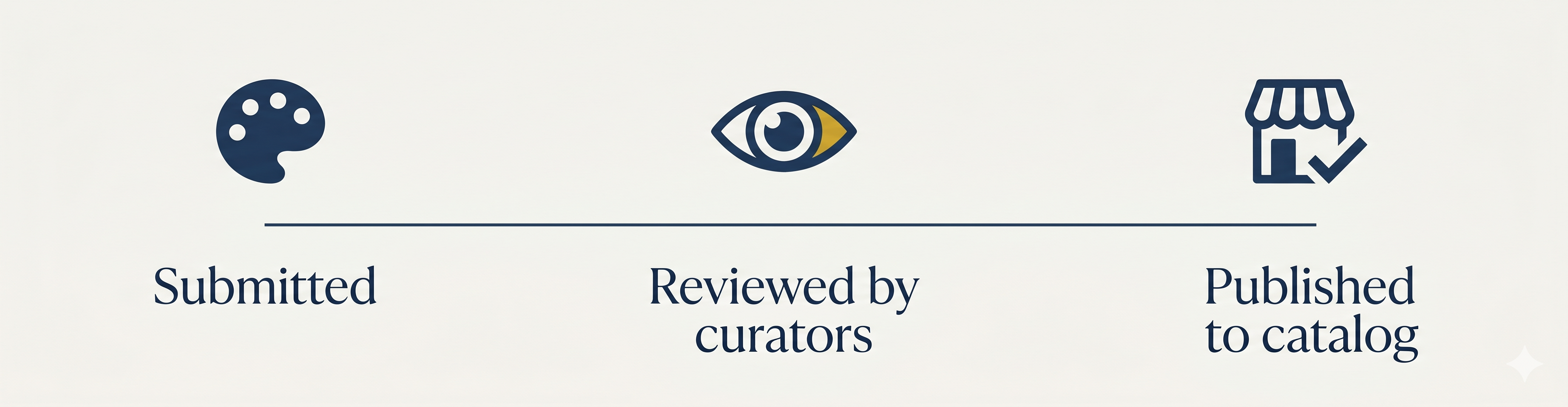
Three stages from generation to approval
Stage 1: Generated
Our system generates candidate designs using AI. This produces a pool of variations — different patterns, colour treatments, and embedded graphic elements — all built on a given QR base.
Quantity at this stage is intentional. Generating many candidates means the curatorial team has a real selection to work with. Most candidates don't make it further.
Stage 2: Evaluated
Each candidate goes through human review. Our curatorial team assesses every design against three criteria:
- Visual quality — Does it look considered? Does it fit the SquareBond aesthetic? Would it be at home on a premium property brochure?
- Contrast integrity — Is the pattern sufficiently distinct from the background across print scenarios? Low contrast fails in the real world even when it looks fine on screen.
- Real-device scan testing — Does it actually scan reliably? The team tests each approved design on physical devices across the major platforms: iOS Camera, Android Camera, Google Lens, and common third-party scanner apps.
A design that passes all three becomes a candidate for approval. A design that fails any one of them is not offered to customers.
Stage 3: Approved for use
Approval confirms that a design is ready to use. Public catalogue placement is a separate curation choice: a collection appears publicly only while it belongs to a category branch selected for the current showcase. Removing a branch from the public catalogue does not undo the design's approval or change its QR lifecycle.
The focused public catalogue
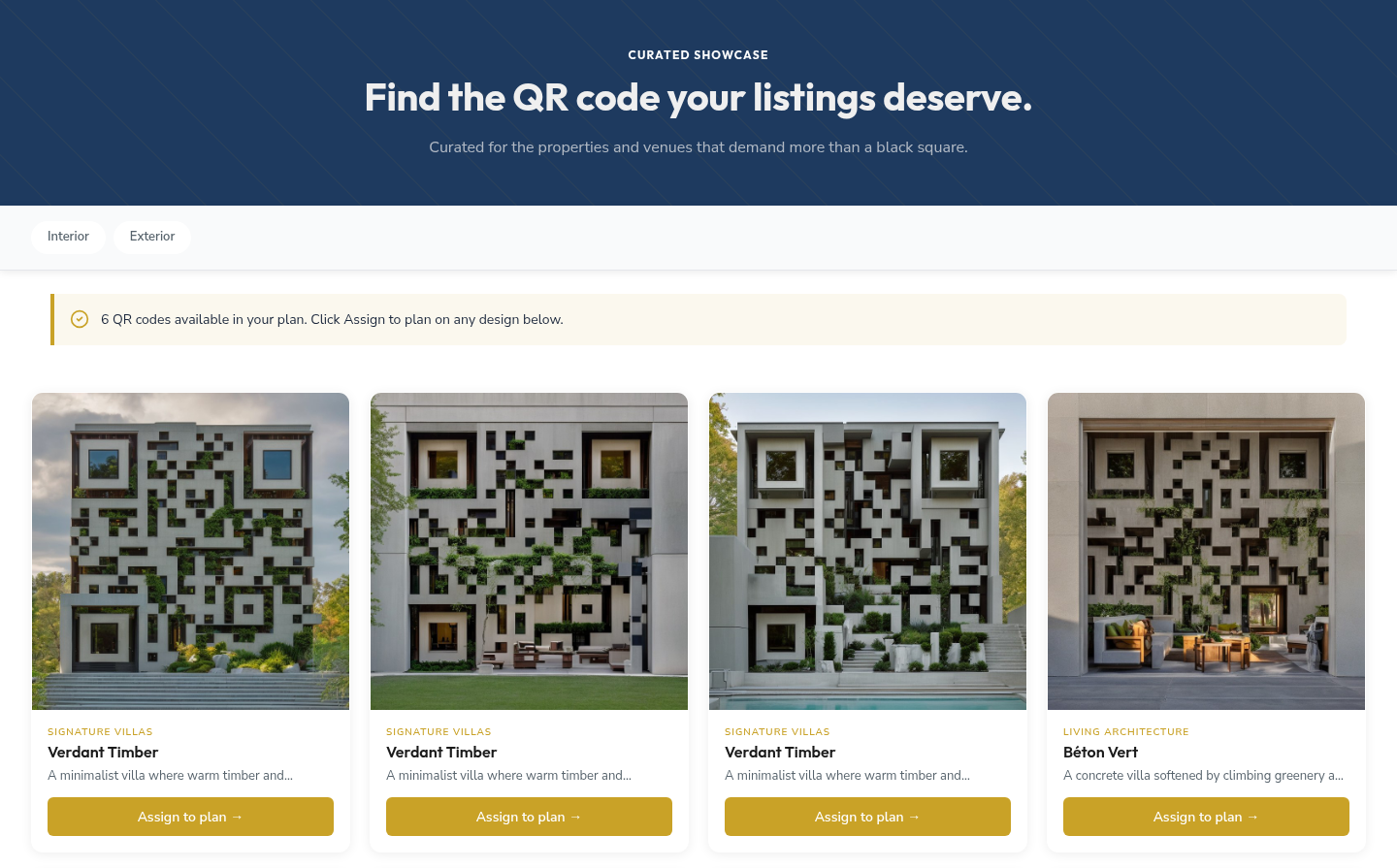
The public shop keeps discovery purposeful. When one top-level family is active, SquareBond treats it as the natural context and shows its useful filters directly — Interior and Exterior in the current property-focused catalogue.
A design linked through any active category path remains public. Designs that belong only to hidden branches stay out of public search, direct product pages, and catalogue discovery.
Prepared vendor offers
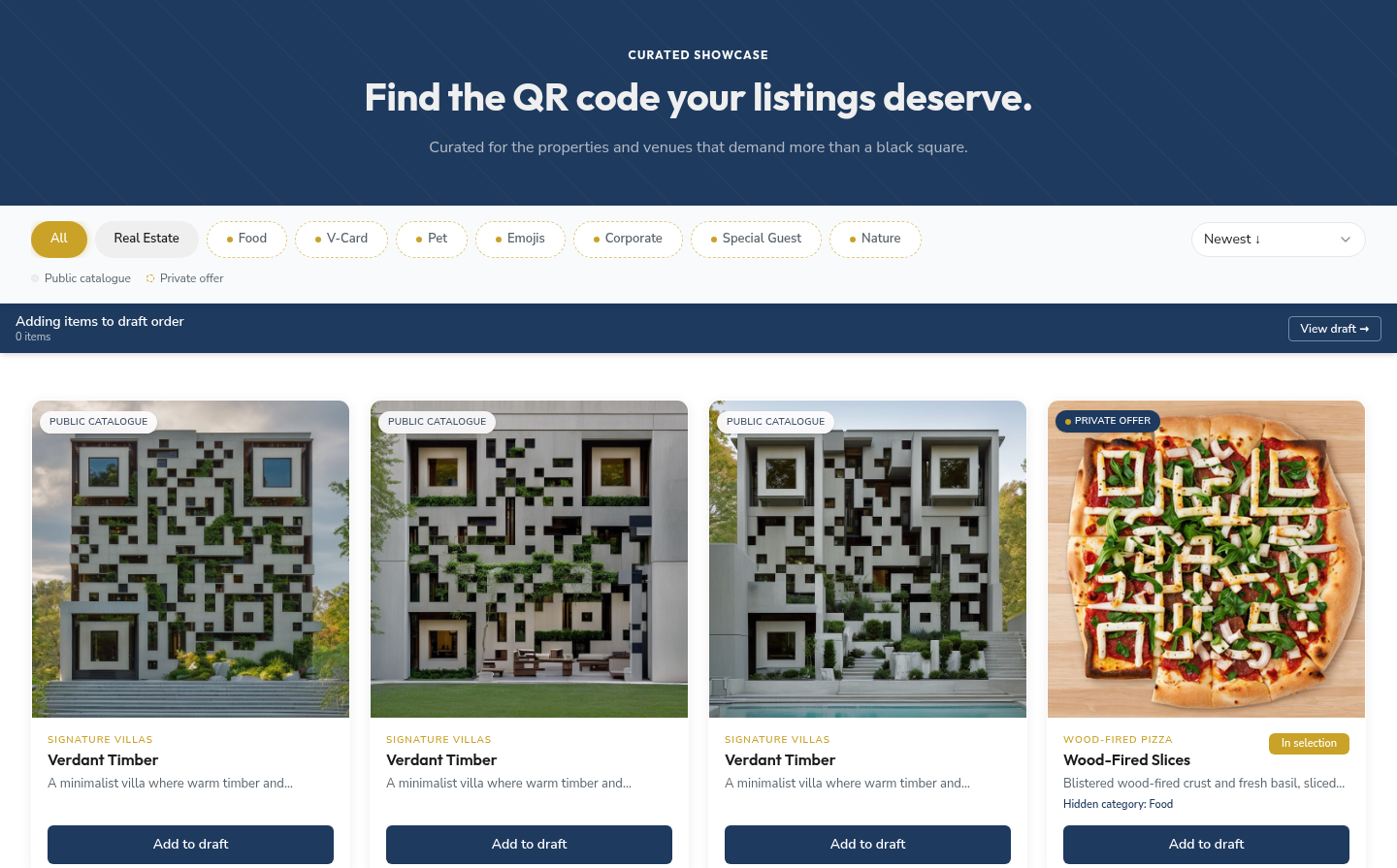
When an authorised vendor or administrator edits a draft order, the catalogue can expand to the complete approved library. Clear labels keep the distinction honest:
- Public catalogue — the design is also available in the public shop.
- Private offer — the design is available for this prepared offer but sits outside the current public category focus.
- Hidden category: Food — the reason is shown directly, without implying a different approval standard.
Only a team member permitted to edit that draft can open the expanded view; a draft link alone does not unlock it.
What the review catches that automation misses
Automated QR validation tools check technical compliance: does the pattern encode the correct data? Does it meet the ISO/IEC 18004 standard? These are necessary checks, and we run them. But they're not sufficient.
A pattern can be technically valid and still fail to scan in real conditions — poor contrast on glossy paper, interference from background graphics, or a combination of error correction level and print size that works at 100% but fails at 75%.
Human review catches these edge cases because human reviewers print the codes, hold them under real lighting, and scan them with real phones. That's a test no automated validator replicates.
Why this matters for you
A failed scan at an open house is a missed connection — a prospective buyer who didn't get to the virtual tour, didn't see the floor plan, didn't book a viewing. That missed connection has a cost.
Catalogue curation is our side of the guarantee. You bring the listing; we bring the verified code. Whether you choose from the public shop or a prepared vendor offer, the scan testing has already been done.
This is also why the public catalogue is focused rather than exhaustive. It keeps the main collection coherent for property marketing while leaving room for a vendor to prepare a more tailored selection when the brief calls for it.
Go deeper
Why AI-generated QR codes have variable scannability
QR code scannability is determined by several interacting factors: module density (how small the individual squares are), error correction level (how much redundancy is embedded for damage tolerance), contrast ratio between foreground and background, and the presence of graphic elements that interfere with the quiet zone or finder patterns.
AI generation optimises for visual interest, not scan reliability. A design that looks striking may have a pattern that's too dense at print scale, or foreground graphics that interrupt the finder squares a scanner needs to locate and orient the code. These are the failure modes the curatorial review is specifically trained to spot.
The "quiet zone" rule
Every QR code requires a quiet zone — a margin of empty space surrounding the pattern — for scanners to correctly detect the boundary of the code. Designs that bleed visual elements into the quiet zone fail consistently on real devices even when they appear to decode correctly in software validators. Our review process includes explicit quiet zone verification.
Frequently asked questions
Can I submit my own design to the catalogue?
SquareBond currently offers designs that go through our internal generation and review process. User-submitted designs are not part of the library at this time.
How long does the approval process take for new designs?
New designs are reviewed on a rolling basis. Timing varies with collection size and the review queue. When a design appears in the public catalogue or a prepared offer, it is ready to use.
Why did a vendor offer include a design I could not find in the public shop?
The public catalogue follows the current category focus. An authorised vendor can draw from the wider approved library while preparing a draft, and the design is marked Private offer so the distinction stays clear.
What happens if a design that passed approval fails to scan on my device?
We stand behind every design in the catalogue. If you encounter a scan failure on a specific device or in a specific print context, contact us at support@squarebond.com. We investigate reported failures and, where confirmed, remove or re-evaluate the affected design.
Is the same approval process applied to every design, or only certain collections?
Yes. Every design offered by SquareBond goes through the same three-stage review, whether it appears in the public catalogue or a prepared vendor offer.
QR Codes 101 → covers the broader scannability picture — what catalogue curation builds on top of.